Monday, August 16, 2010
VOCES 1 - first edition of a new independent Cuban magazine
The magazine is over 60 pages long with hi-rez graphics, photography, and articles by some of Cuba's leading writers, bloggers, and intellectuals both from within the island and abroad - the list includes Yoss, Ena Lucia Portela, Wendy Guerra, Ivan de la Nuez, Emilio Ichikawa, Yoani Sanchez, Reinaldo Escobar, Antonio Jose Ponte, Juan Abreu, Jesus Diaz, and Pardo himself.
Check it out at the link below.
********
Saludos,
Desde La Habana les enviamos con gusto este primer número de nuestra revista independiente VOCES.
Ojalá sea de su agrado.
VOCES 1 también puede ser descargada en alta resolución para imprimir en: http://www.scribd.com/doc/35770089/voces1.
Pueden difundirla libremente.
Se aceptan sugerencias y colaboraciones,
Gracias
Orlando Luis Pardo Lazo
Sent via BlackBerry from T-Mobile
Monday, August 9, 2010
Freedom to Travel - Act Now!
Right to Travel to Cuba - An Occasional Newsletter August 2010
In this issue
Administration Finding Its Way
Reinforcement from the People
Congress Delays Action
Cuba Not Waiting
Obama Campaign Pledge
Dear Sir,
Several news stories on Friday suggested the White House is on the verge of announcing important changes in people-to-people travel.
This feels like a trial balloon, so it is important that the President hear at once that his initiative is broadly welcomed and that it should be as expansive as possible.
If the only voices are of Cuban American hard liners, we risk watered down reforms as took place in April 2009.
At the same time, the August recess is an ideal time to press House and Senate members to pass the agricultural trade and travel bill in September. Special attention is needed for members of the House Committee on Foreign Affairs where the bill faces desperate opposition led by ranking member Ileana Ros-Lehtinen.
John McAuliff
Sunday, August 8, 2010
Tell Obama what you think - Travel to Cuba
Saturday, August 7, 2010
PLEASE CIRCULATE !!!
Rumor has it that Obama is considering easing Cuba travel restrictions. Read the full story here:
http://www.kansascity.com/2010/08/06/2134353/us-said-to-be-near-easing-restrictions.html
If the rumor (leak) is actually a weather balloon,,,,, we need to let Obama know we've got his back!!
Here's what you can do!
1. Call the White House Comment Line 202-456-1111 and leave words of encouragement, like: PLEASE let me travel to Cuba!!! Short and sweet... remember those answering the phone are just score keepers.
2. Leave the same comment at http://www.whitehouse.gov/contact
3. Leave a comment at the end of the Kansas City Star article listed above.
4. Sign this petition http://www.change.org/petitions/view/mr_president_dont_wait_for_congress_to_open_travel_to_cuba
Nos vemos el La Habana!
Sent via BlackBerry from T-Mobile
U.S. said to be near easing restrictions on travel to Cuba
By JUAN O. TAMAYO, Friday, August 6, 2010
McClatchy Newspapers
The Obama administration will soon ease some restrictions on U.S. travel to Cuba and other sanctions following Havana's promise to free political prisoners, according to growing but unconfirmed reports.
Two persons close to the administration told El Nuevo Herald on Friday the decision has been made and will be announced in the next two weeks. Another said he's heard the reports but cautioned they could be "trial balloons."
The key change will be an expansion of educational and cultural travel, which accounted for about 2,000 visits in 2009, said two of the sources. Many academics have urged President Barack Obama to expand those visits, drastically trimmed by the George W. Bush administration.
One of them added that Obama also will restore the broader "people-to-people" category of travel, which allows "purposeful" visits to increase contacts between U.S. and Cuban citizens.
Though that category requires prior U.S. licenses for the trips, it is fuzzy enough to allow for much expanded travel to Cuba, the source added. All asked for anonymity because they did not want to be seen as pre-empting a White House announcement.
Friday, August 6, 2010
Los nietos de la Revolucion: Seremos como el Che?
The first paragraph sums up the article:
"The Cuban revolution never was nor has ever been democratic. Neither can it be called communist - not now nor before. Instead it is a vulgar and vile state capitalism called "Fidelismo."
This according to writer and graphic designer Canek Sánchez Guevara, the eldest gransdson of guerrilla Ernesto ''Che'' Guevara. Son of Guevara's eldest daughter, Hilda (Hildita) Guevara, Sánchez Guevara (30) was born in Cuba and is a citizen of Mexico where he lives.
DECLARACIONES DEL NIETO MAYOR DEL CHE A UNA REVISTA MEXICANA
La revolución en Cuba ''no fue, ni nunca ha sido democrática'' y tampoco es comunista, ni ahora ni antes, ''sino un vulgar y vil capitalismo de Estado llamado "Fidelismo,'' afirmó el nieto del guerrillero Ernesto ''Che'' Guevara, Canek Sánchez Guevara.
En una carta y una Autoentrevista que publica hoy el semanario mexicano ''Proceso'', Canek criticó duramente el ''mesianismo" de Fidel Castro y la pérdida de rumbo que hizo de la revolución, pasando ''del joven revolucionario al viejo tirano'' que ''falsificó'' un noble ideal.
''La revolución parió una burguesía corrupta, aparatos represivos dispuestos a defenderla del pueblo y una burocracia que la alejaba de éste. Pero sobre todo fue antidemocrática por el mesianismo casi religioso de su líder'', señaló. En sus escritos, Canek desnuda uno a uno los puntos que han ido alejando a la revolución cubana de su noble propósito original, como ''la criminalización de la diferencia,'' mediante la ''persecución de homosexuales, hippies, libre-pensadores, sindicalistas y poetas'' y la instalación de una ''burguesía socialista férrea (...) fingidamente proletaria'' .
''La revolución hace años falleció en Cuba: hubo de ser asesinada por quienes la invocaron para evitar que se volviera contra ellos, tuvo que ser institucionalizada y asfixiada por su propia burocracia, por la corrupción, por el nepotismo y por la verticalidad de la tan mentada organización: el Estado revolucionario cubano'', dijo.
Además, no dudó en calificar el régimen de Castro como una dictadura y acusó al dirigente de traicionar los ideales iniciales de la revolución, reseñó EFE.
''En efecto, Fidel liberó a Cuba de la gangsteril dictadura batistiana, pero con su obstinada permanencia sólo logró volverse, él mismo, otro dictador'', aseveró. ''Todas mis críticas a Fidel Castro parten de su alejamiento de los ideales libertarios, de la traición cometida en contra del pueblo de Cuba y de la espantosa vigilancia establecida para preservar al Estado por encima de sus gentes'', agregó.
El nieto mayor del Che Guevara señala que la represión que se vive en la isla, con la ''vigilancia perpetua sobre los individuos'' y ''la prohibición de las asociaciones que puedan hacer al margen del Estado'' no es sino ''un vulgar capitalismo de Estado'' que, según él, morirá con Fidel. ''Seamos honestos, un joven rebelde ahora, similar a como fue Fidel Castro en el pasado, en la Cuba de hoy, sería inmediatamente fusilado, y no condenado al exilio'', como lo fue él, aseguró.
Sánchez Guevara remata diciendo que el Marxismo en Cuba es ''sólo una asignatura escolar'' y que desde las ideas de Marx es desde donde ''puede verse en su conjunto el estrepitoso fracaso de un ideal totalmente falsificado' '.*
El nieto mayor del Che Guevara nació en Cuba, tiene 30 años y posee la ciudadanía mexicana.
Actualmente vive en Oaxaca y es escritor y diseñador gráfico. Su madre es Hilda Guevara, la primogénita del guerrillero.
Sent via BlackBerry from T-Mobile
Thursday, August 5, 2010
La Flaca in the Washington Post
By Yoani Sánchez
Thursday, August 5, 2010
HAVANA - Fidel Castro's return to public life after a four-year absence provokes conflicting emotions here. His reappearance surprised a people awaiting, with growing despair, the reforms announced by his brother Raúl. While some weave fantasies around his return, others are anxious about what will happen next.
The return of a famous figure is a familiar theme in life as in fiction -- think Don Quixote, Casanova or Juan Domingo Perón. But another familiar theme is disappointment -- of those who find that the person who returns is no longer the person who left, or at least not as we remember him. There is often a sense of despair surrounding those who insist on coming back. Fidel Castro is no exception to this flaw inherent in remakes.
The man who appeared on the anniversary of "Revolution Day" last week bore no resemblance to the sturdy soldier who handed over his office to his brother in July 2006. The stuttering old man with quivering hands was a shadow of the Greek-profiled military leader who, while a million voices chanted his name in the plaza, pardoned lives, announced executions, proclaimed laws that no one had been consulted on and declared the right of revolutionaries to make revolution.
Although he has once again donned his olive-green military shirt, little is left of the man who used to dominate television programming for endless hours, keeping people in suspense from the other side of the screen.
The great orator of times long past now meets with an audience of young people in a tiny theater and reads them a summary of his latest reflections, already published in the press. Instead of arousing the fear that makes even the bravest tremble, he calls forth, at best, a tender compassion. After a young reporter calmly asked a question, she followed up with her greatest wish: "May I give you a kiss?" Where is the abyss that for so many years not even the most courageous dared to jump?
A significant sign that Fidel Castro's return to the microphones has not being going over well is that even his brother refused to echo, in his most recent speech to parliament, the former leader's gloomy prognostication of a nuclear armageddon that will start when the United States launches a military attack against North Korea or Iran. Many analysts have pointed out that the man who was known as the Maximum Leader is hardly qualified to assess the innumerable problems in his own country, yet he turns his gaze to the mote in another's eye. This pattern is familiar, with his discussions of the world's environmental problems, the exhaustion of capitalism as a system and, most recently, predictions of nuclear war.
Others see a veiled discontent in his apparent indifference toward events in Cuba. Yet this thinking forgets the maxim: Even if he doesn't censure, if Caesar does not applaud, things go badly. It is unthinkable that Fidel Castro is unaware of the appetite for change that is devouring the Cuban political class; it would be naive to believe that he approves. For years, so many lives and livelihoods have hung on the gestures of his hands, the way he raises his eyebrows or the twitch of his ears. Fidel watchers now see him as unpredictable, and many fear that the worst may happen if it occurs to him to rail against the reformers in front of the television cameras.
Perhaps this is why the impatient breed of new wolves do not want to stoke the anger of the old commander, who is about to turn 84. Some who intended to introduce more radical changes are now crouching in their spheres of power, waiting for his next relapse.
Meanwhile, those who are worried about the survival of "the process" are alarmed by the danger his obvious decline poses to the myth of the Cuban revolution personified, for 50 years, in this one man. Why doesn't he stay quietly at home and let us work, some think, though they dare not even whisper it.
We had already started to remember him as something from the past, which was a noble way to forget him. Many were disposed to forgive his mistakes and failures. They had put him on some gray pedestal of the history of the 20th century, capturing his face at its best moment, along with the illustrious dead. But his sudden reappearance upended those efforts. He has come forward again to shamelessly display his infirmities and announce the end of the world, as if to convince us that life after him would be lacking in purpose.
In recent weeks, he who was once called The One, the Horse or simply He, has been presented to us stripped of his captivating charisma. Although he is once again in the news, it has been confirmed: Fidel Castro, fortunately, will never return.
Yoani Sánchez is a writer in Cuba. Her awards include the 2009 Maria Moors Cabot Prize. She blogs at www.desdecuba.com/generationy. This column was translated from Spanish by M.J. Porter.
Sent via BlackBerry from T-Mobile
Tuesday, August 3, 2010
Translating Cuba: What, Why, How?
The folks who translate the DesdeCuba.com / VocesCubanas.com Cuban blogs into English (see HemosOido.com) have just launched a new blog portal entitled Translating Cuba where you can one-stop-shop for access to the English version of more than 20 independent Cuban blogs, as well as the English version (full translation in progress) of the polémica intelectual, the war of e-mails between Cuban writers and intellectuals from January-February, 2007 that was the spark that led to the creation of Generación Y in April 2007.
The site also features a page entitled What, Why, How?
So far all that's up is the "What." Here it is:
Translating Cuba is a compilation of English translations from Cuban blogs. The bloggers included here share a number of characteristics.
They:
What they don’t share is a single point of view. Our hope is that the voices on this site will mirror the free, open, and plural society we all know that Cuba is ultimately destined to be.
- Write from the island of Cuba.
- Are independent, that is they are not paid by the Cuban government.
- Write under their own names.
- Their blogs contain material of wide general interest.
- Their blogs are updated on a regular basis.
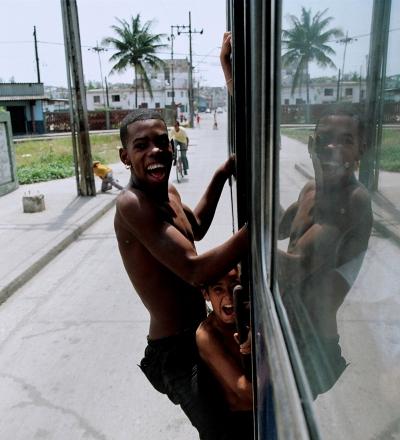
The Root: Photo Essay from Orlando Luis Pardo Lazo
Race in Cuba: The Root Interviews Carlos Moore
By Achy Obejas
July 29, 2010
Achy Obejas talks to an Afro-Cuban intellectual who says that Cuba's gotten a pass on race for far too long.
Dr. Carlos Moore is an ethnologist and political scientist specializing in African, Latin American and Caribbean affairs. Frequently controversial in his views, he is the author of Fela: This Bitch of a Life and Pichon: Race and Revolution in Castro's Cuba: A Memoir, among others. Following exile from his native Cuba, Moore has lived and worked in many countries, including the United States, Senegal and, his current base, Brazil. He holds two doctorates from the University of Paris and is fluent in five languages.
The Root: Last year, you put together a declaration, called ''Acting on Our Conscience,'' which called Cuba on its racism. It was signed by more than 60 African-American intellectuals. Why did you feel the need to make this kind of statement? Why was it important to get African-American support for such a statement?
Carlos Moore: Actually, Dr David Covin, Dr. Iva Carruthers and I put the declaration together. I took the initiative and acted as the facilitator. However, it was a tripartite initiative. We agreed that, because of the mythology around Fidel Castro, socialist Cuba had gotten a pass on race for too long, contrary to most other places. We felt it was high time to call a "cat" a cat and a "rat" a rat, regarding this whole question of racism in Cuba. The blatantly unjust arrest and imprisonment of Dr. Darsi Ferrer, the human and civil rights activist, was the "drop that filled the cup." However, I am convinced that sooner or later such a declaration would have come. It was inevitable: Too many people have gone to Cuba and realized that the regime was lying to them concerning race.
TR: The Cuban Revolution has long been regarded as a bulwark against racism and as an ally of Africa. How did we get here, where African-American intellectuals need to call Cuba out about racism?
CM: The world has changed a lot since the collapse of Communism. Before the Soviet empire tumbled, Marxist regimes were considered to be off-limits for any criticism about their violation of civil rights, their trampling on human rights or their perpetration of racial discrimination. Such regimes enjoyed a sort of automatic immunity from criticism. "First World" leftist sympathizers made it their job to shield those despotic regimes from critical scrutiny, claiming that to criticize them was to be an ''agent of the CIA.''
So for decades these ideological bulldogs intimidated most people. But a time comes when people stop fearing a bulldog; that happened when the Soviet empire tumbled. On the other hand, over the years African Americans in general have gained greater knowledge about the world beyond U.S. borders, and the complexities of countries in so-called 'Latin' America. Thousands of African Americans have visited Cuba over the past 50 years. They have seen the reality and heard it, too, from the mouths of black Cubans. Many have even been discriminated there for being black and suffered humiliation. Sooner or later, the cumulative impact of all that would have produced a principled statement such as the one that was issued.
TR: But surely the Cuban Revolution has moved the issue of race forward, hasn't it? Is there any question that there have been achievements as far as race, representation, race relations and racial equality in Cuba since 1959?
CM: My perspective on race relations is perhaps quite different from that of most people in that I do not see race as being primarily a question of interpersonal relations. I see it as being, fundamentally, a question of relations of power over the distribution of resources along racial lines. And by race, I mean phenotype, not biology. Consequently, I do not analyze racial matters in terms of "betterment," "achievement," "advancement," or "representation." I view maters of race in terms of the power to distribute or deny resources.
That is why I do not see socialist Cuba as "less" or "more" racist than pre-1959 Cuba. What has shifted is the consciousness that now exist among blacks of their overall inferior position in society, despite the Revolution. No doubt because of the socioeconomic transformations brought about by the socialist reforms, blacks as a whole enjoy greater educational access today. Yet, they remain crushingly at the bottom, whereas whites continue crushingly at the top. Such is the equation of power that -- before and after the Revolution -- prevails in Cuba.
TR: What does Cuba need to do now to address racism?
CM: Although racism does create its own sustaining ideologies (Nazism, apartheid, racial democracy, etc.), it is not an ideological phenomenon per se. I believe racism to be something much more dangerous and intractable than an ideology -- for example, a historically derived, over-arching consciousness that is materially and psychologically beneficial to a particular racial segment of humankind. If racism weren't concretely beneficial to that segment, it certainly wouldn't persist in the world. Therefore, my take on race is that racism exists on at least three different and autonomous but interdependent dimensions that must be confronted simultaneously: the political, economic and judicial structures of power; the day-to-day etiquette of interpersonal relations; the social imaginary where Otherness is mythologized and re-signified through cultural attitudes and patterns, value systems and aesthetic norms.
All three dimensions act conjointly in exclusive detriment of the historically inferiorized, conquered racial segment. Hence, addressing racism implies a determination to attack it frontally in all three dimensions. That was never attempted in Cuba either before or after 1959.
TR: What, if anything, makes Cuba unique when it comes to matters of race?
CM: Absolutely nothing! In matters of race, Cuba is no different from the Dominican Republic, Puerto Rico, Venezuela, Brazil or any other of the so-called "Latin" American countries. The whole premise based on what is termed "mulatto culture" or "mestizo race" relies on strictly racist assumptions. Everywhere in this hemisphere, you will find a tiny, white elite of wealth monopolizing power and resources and keeping the rest of society at bay. And despite the many social advantages brought about by the Revolution, Socialist Cuba is no exception. The idea of a "Cuban exceptionalism" based on so-called race-mixing, is a self-indulgent racial myth in itself!
Achy Obejas is an author whose most recent book is Ruins, a novel about Cuba in the Special Period. She was born in Cuba and came to the United States by boat in 1963. Since then she has returned to Cuba innumerable times. She writes about Cuba for The Root and other U.S.-based publications.
Monday, August 2, 2010
Economix 101
Speaking of the Cuban economy, I just got back from sunny Miami where I attended the 20th annual conference of ASCE (The Association for the Study of the Cuban Economy).
Perhaps the most interesting and enlightenning panel was on recent changes in Cuban agriculture, 'absurdly' entitled, "Waiting for Godot."
The most revealing paper presented was by the Havana-based Reuters/Financial Times correspondent Marc Frank, who shared his soundings of Cuban farmers as they assessed their experience working under Raul.
I'd say they gave him a collective C-, meaning that they have seen encouraging changes that give them much greater flexibility in planting, growing, transporting, and selling their produce. What Frank described were experiments in slowly phasing out the acopio (the requirement that farmers sell a large portion of their crop to the state at a fixed price).
While this is indeed encouraging, the downside is that for every positive development farmers can cite 2-3 continued bureaucratic or political obstacles in their way.
In other words, they appreciate the changes but point out that there's a LONG way still to go and that the government moves painfully slowly with any reforms.
I'll see if Frank shares his assessment with readers in the coming days.
Cuba to Cut Workers and Relax Business Rules
By THE ASSOCIATED PRESS
Published: August 02, 2010
HAVANA (AP) - The Cuban government will scale back controls on small businesses, lay off unnecessary workers and allow more self-employment, President Raúl Castro said Sunday, major steps in a country where the state dominates nearly every facet of the economy.
But Mr. Castro, speaking at the opening session of Parliament, also scoffed at what he said was media speculation that Cuba planned sweeping economic changes to dig itself out of a financial crisis. "With experience accumulated in more than 55 years of revolutionary struggle, it doesn't seem like we're doing too badly, nor that desperation or frustration have been our companions along the way," he said.
About 95 percent of all Cubans work for the government, a sector Mr. Castro called "considerably bloated." Those who are laid off, he said, will be retrained or reassigned.
Sent via BlackBerry from T-Mobile