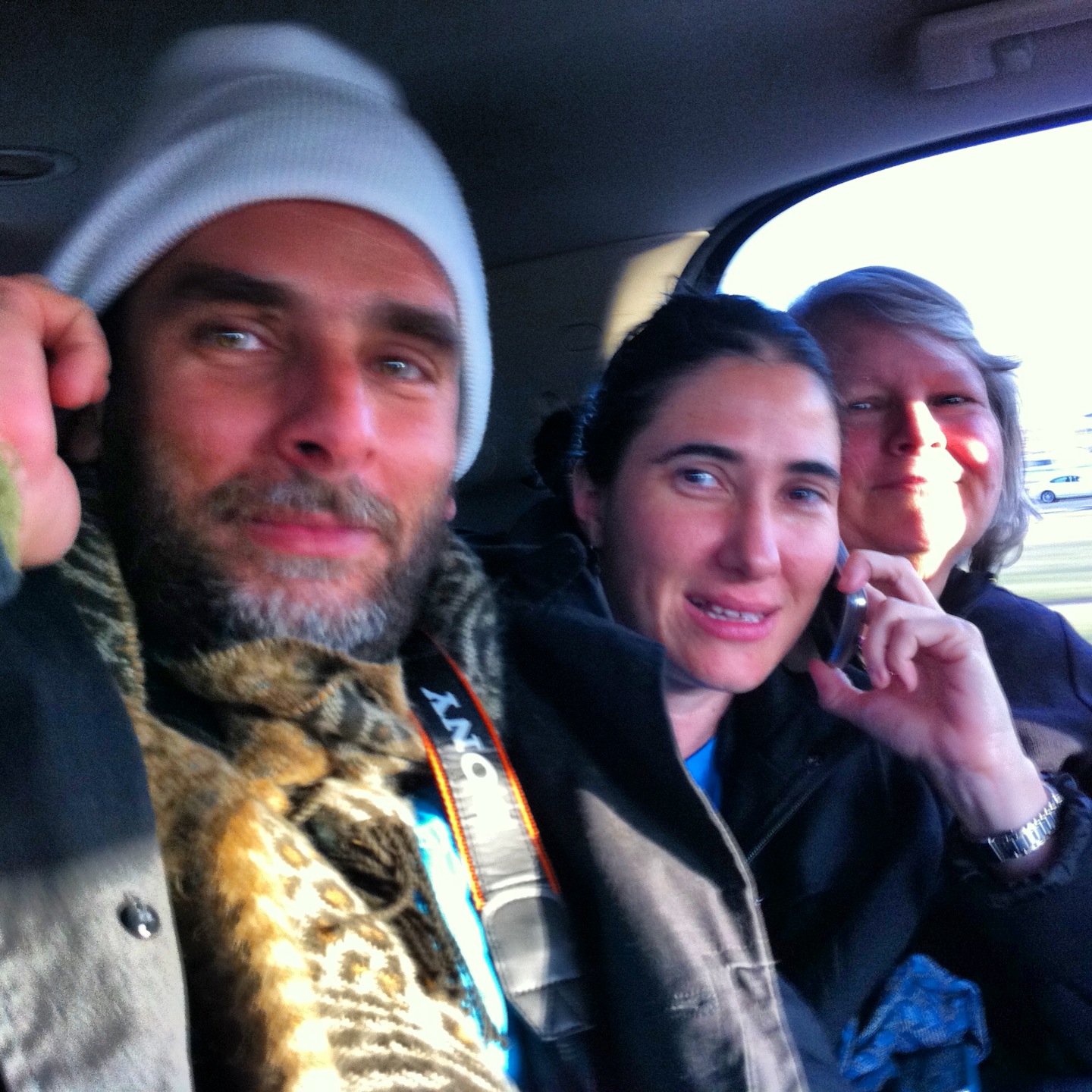
Orlando Luis Pardo Lazo, Yoani Sánchez, & MJ Porter.
(Photo by Ted Henken).
(Photo by Ted Henken).
Just over a month ago at 5:15 p.m. on Thursday, March 14 Hurricane Yoani Sánchez blew into New York and Washington, D.C. from Mexico. Since I had the distinct honor of helping to set up her itinerary, accompanying her, and interpreting for her during that week (Mar. 14 - Mar. 21), I was unable to update the blog with any of my own observations of the various events we undertook together. However, I did try to catalogue things as they happened with fairly constant Twitter updates and links to photos, videos, and some of the many articles that came out about her visit.
On an emotional, human level, the most powerful thing for me (as someone who had met with and interviewed her in Havana before) was witnessing her meet many close friends and long-time collaborators on her blogging adventure for the very first time in New York. These emotional encounters really brought home to me the power of social media to convene like-minded people with different talents, from different places, with different amounts of free time to work on projects of creative collaboration (Net guru Clay Shirky has called this "cognitive surplus" or "crowd-sourcing") that would be impossible without the Internet.

Hearing Sánchez speak at places as diverse as Google, the Committee to Protect Journalists, the Inter-American Commission on Human Rights of the OAS, and the UN; the New York Times, the Wall Street Journal, Bloomberg, CNN, and the Washington Post; the Cato and Brookings Institutes; and Columbia, NYU, CUNY, Cardozo Law School, and Georgetown Universities, for me there are five takeaways in terms of the message of her trip:

Arturo Villar, Yoani Sánchez, and El Yuma.
1. Raul's Reforms: Don't believe the hype! (to quote a hip-hop guru other than Jay-Z) - that is, while the economic reforms so far enacted under Raul Castro are positive and go in the right direction, their lack of depth and glacial slowness is exasperating, especially since they include almost nothing in the realm of civil and political reforms. (At one point, Yoani even half-joked to me that Obama's efforts at updating US policy could be described similarly: while they are positive and move in the right direction - toward openness and engagement -, they also lack depth and are frustratingly slow). In other words, we should not expect the important and necessary changes in Cuba to come from either the Cuban or the US government.
2. The Birdcage: La cage aux folles - in appearance after appearance Yoani has matched the witty and incisive written words we all knew her for, with a poised vocal eloquence, stamina, and don de palabra that caught many of her listeners by surprise. Where does she get the confidence, energy, and strength?, many people wondered.
 She also impressed her listeners with a clarity and quiet femininity as she delivered one devastating criticism of the Cuban regime after another, and in a way - often seated in conversation with a female interlocutor - that put many of the traditionally intransigent and bombastic Castro critics to shame - as noted by Carlos Alberto Montaner when he wrote, "In more than half a century of tyranny, nobody has been more effective in the task of dismantling the regime’s myths and exposing Cubans’ miserable living conditions. [...] Yoani’s weapons have been sincerity, a crushing logic, an innate ability to communicate, and her own attractive personality." (Photo courtesy of David Garten).
All this was often combined with her expert use of incisive vignettes, powerful stories, and apt metaphors to make her convincing points. Her favorite metaphor of all was the birdcage: when asked about Revolutionary Cuba's free and universal health care and education, she wold invoke the image of a bird imprisoned in a gilded cage - always expected to be grateful for the free feed and water but never allowed to escape through the bars of the cage and fly free. And by the way, the alpiste y agua ain't what they used to be!

All this was often combined with her expert use of incisive vignettes, powerful stories, and apt metaphors to make her convincing points. Her favorite metaphor of all was the birdcage: when asked about Revolutionary Cuba's free and universal health care and education, she wold invoke the image of a bird imprisoned in a gilded cage - always expected to be grateful for the free feed and water but never allowed to escape through the bars of the cage and fly free. And by the way, the alpiste y agua ain't what they used to be!
3. Hope and Change: The kind you have to believe in to see - Though we should not expect major changes from on-high, Cuba IS changing in significant ways because Cubans themselves are changing (from the inside out) - losing their fear and beginning to make new demands and form civil society movements. As a response, Cubans on the outside should not waste their energy looking back to the past in anger, but forward to the future with optimism. However, such optimism should not be an escape or illusion from the very hard work and road ahead of helping the emergent Cuban civil society in concrete ways.

4. New Times: Call for New Policies - Prior to her visit to Washington, D.C., Sánchez was often asked what demands she would make to the US government. "I'm not going there to ask for anything," she repeatedly responded. "Because the necessary changes in Cuba must come from within Cuba."
At the same time, however, she often insisted when pressed that the embargo hasn't worked and it was time to try something new. For her, it only serves as a convenient scapegoat for the Castro regime to blame everything on - "from the lack of tomatoes and potatoes on our dinner tables, to the lack of the right of assembly and association, to the absence of Internet... I'd love to see how they explain these problems when they no longer have the embargo as a whipping boy."
 She would also often add that the internal changes in Cuba call for a fundamental re-examination of US policy, that would double-down on the Obama administration's principled engagement, expand people-to-people contacts, and promote new and innovative ways of reaching out to the Cuban people highlighting the liberating power of technology. "It's time to update many policies," she told Telemundo (in the main interview linked below) when asked what she would tell President Barack Obama if she had the chance. "It is also time to strengthen and help empower Cuban society technologically, materially, and in all senses." Such help could come from US policy-makers, but Sánchez more often emphasized the role US citizens and Cuban-Americans should have in lending a hand of "citizen solidarity" to Cubans on the island. (Photo of Yoani Sánchez supporter taken at NYU by Tracey Eaton).
At the same time, however, she often insisted when pressed that the embargo hasn't worked and it was time to try something new. For her, it only serves as a convenient scapegoat for the Castro regime to blame everything on - "from the lack of tomatoes and potatoes on our dinner tables, to the lack of the right of assembly and association, to the absence of Internet... I'd love to see how they explain these problems when they no longer have the embargo as a whipping boy."

She also suggested that the Obama administration surprise Cuba by offering to sit down and discuss their differences, but that any such discussion should rightly include the voices of Cuban civil society and the Cuban diaspora.
Just before she met with US Senator Marco Rubio, I reminded her of his criticism of US visitors to the island who - in his words - "visit Cuba as if it were a zoo." When she met with him, she told him that she actually liked his metaphor but that he should imagine himself inside the cage with the other animals. Wouldn't he prefer that someone on the outside come and help unlock the cage, instead of abandoning him inside?

"There is no 'you' and 'us'," she declared.
"There is only an 'us'."