Here are a few more key passages from the Foreign Affairs article, "Digital Disruption," by Google's Schmidt and Cohen:
Saturday, November 6, 2010


Digital Disruption: Mobile Technology and Civil Society according to Google's Schmidt and Cohen
This just in from one of my stellar students.
"The Digital Disruption: Connectivity and the Diffusion of Power"
By Eric Schmidt and Jared Cohen
Foreign Affairs, November/December 2010
A video of the presentation is available here and audio here.
Summary:
Increased connectivity allows for the spread of liberal, open values but also poses a number of dangers. To foster the free flow of information and challenge authoritarian regimes, democratic states will have to learn to create alliances with people and companies at the forefront of the information revolution.
Opening section:
The advent and power of connection technologies -- tools that connect people to vast amounts of information and to one another -- will make the twenty-first century all about surprises. Governments will be caught off-guard when large numbers of their citizens, armed with virtually nothing but cell phones, take part in mini-rebellions that challenge their authority. For the media, reporting will increasingly become a collaborative enterprise between traditional news organizations and the quickly growing number of citizen journalists. And technology companies will find themselves outsmarted by their competition and surprised by consumers who have little loyalty and no patience.
"The Digital Disruption: Connectivity and the Diffusion of Power"
By Eric Schmidt and Jared Cohen
Foreign Affairs, November/December 2010
A video of the presentation is available here and audio here.
Summary:
Increased connectivity allows for the spread of liberal, open values but also poses a number of dangers. To foster the free flow of information and challenge authoritarian regimes, democratic states will have to learn to create alliances with people and companies at the forefront of the information revolution.
Opening section:
The advent and power of connection technologies -- tools that connect people to vast amounts of information and to one another -- will make the twenty-first century all about surprises. Governments will be caught off-guard when large numbers of their citizens, armed with virtually nothing but cell phones, take part in mini-rebellions that challenge their authority. For the media, reporting will increasingly become a collaborative enterprise between traditional news organizations and the quickly growing number of citizen journalists. And technology companies will find themselves outsmarted by their competition and surprised by consumers who have little loyalty and no patience.
Friday, November 5, 2010
It Ain't Your Father's Cuba (but is it still his exile?)

My friend and colleague Arturo Lopez-Levy just sent me the following link to his new commentary in Foreign Policy magazine written in reaction to the election of Marco Rubio to the US Senate and Rep. Ileana Ros-Lehtinen's move to become head of the Committee on Foreign Relations now that the Republicans control Congress.

The problem is that we keep waiting for this "new generation" of Cuban migrants to make their voices heard by breaking with the old school hardliners and electing someone with a more pragmatic, pro-engagement approach to Cuba.
But it hasn't happened.
What's so special about Cuba(ns)?

WNYC's public radio/NPR station has a new website and blog - "It's a Free Country."

"As a matter of principle," he writes, "and given our self-image as a nation committed to fair play, we should immediately end the favoritism with which we treat Cuban unauthorized immigrants."
His main argument supporting this position is that the Cold War ended in 1991 and Cubans' special treatment as "automatic refugees" should have ended with it. But anyone familiar with U.S.-Cuban relations knows that while the Cold War may have ended with the collapse of the USSR, no one seems to have told Washington and Havana that the war is over.
So, should Cubans continue to be aforded special treatment and political asylum as refugees, or should they be treated like any other immigrants? Readers of El Yuma can weigh in here or go to the comments section of Rudy's post above where a lively discussion is already underway.

My two cents: Refugee and asylum status should be granted on the basis of an individual's well-founded fear of persecution. Thus, some Cubans can rightfully claim persecution and should be granted refugee status in the U.S. But refugee status should not be granted to the nationals of any nation en masse. Such a policy sets up a double standard and cheapens the value of the refugee distinction. Also, imagínate, what if we granted that same special treatment to todos los chinos, hasta el yuma estaria hablando en chino dentro de poco!
Buena Vista Social Blog - A la venta!

A new book has just been published in Spain (in Spanish) about the emerging Cuban blogosphere. It is entitled, Buena Vista Social blog: The Internet and Freedom of Expression in Cuba.
Here is a link to the table of contents.
El Yuma even has his own essay among the 25 entries that make up the book. It is entitled, "En busca de la 'Generación Y': Yoani Sánchez, la blogósfera emergente y el periodismo ciudadano de la Cuba de hoy," pp. 201-242 [In Search of Generation Y: Yoani Sánchez, the emergent Cuban blogosphere, and citizen journalism in Today's Cuba].
Keep reading below for more infomation on the book and its 25 contribuitors.
Plane With 68 Aboard Crashes in Cuba
AP: November 05, 2010
HAVANA (AP) - A passenger plane flying from the eastern city of Santiago de Cuba to Havana crashed with 68 people aboard, Cuba's state television reported on Thursday night.
There was no immediate word on whether any passengers survived the crash.
State television said the AeroCaribbean flight went down near the village of Guasimal, in Sancti Spíritus Province. It was carrying 61 passengers and a crew of seven. The report said that 28 of the passengers were foreigners, but it did not provide a breakdown of their nationalities.
In Havana, relatives of those on board the plane were kept away from other passengers.
The newscast gave no details on what happened, saying only that the cause of the crash was being investigated.
The flight was one of the last to leave Santiago de Cuba for Havana ahead of Tropical Storm Tomas, which was on a track to pass between Cuba and Haiti.
Sent via BlackBerry from T-Mobile
HAVANA (AP) - A passenger plane flying from the eastern city of Santiago de Cuba to Havana crashed with 68 people aboard, Cuba's state television reported on Thursday night.
There was no immediate word on whether any passengers survived the crash.
State television said the AeroCaribbean flight went down near the village of Guasimal, in Sancti Spíritus Province. It was carrying 61 passengers and a crew of seven. The report said that 28 of the passengers were foreigners, but it did not provide a breakdown of their nationalities.
In Havana, relatives of those on board the plane were kept away from other passengers.
The newscast gave no details on what happened, saying only that the cause of the crash was being investigated.
The flight was one of the last to leave Santiago de Cuba for Havana ahead of Tropical Storm Tomas, which was on a track to pass between Cuba and Haiti.
Sent via BlackBerry from T-Mobile
Thursday, November 4, 2010
Marco Rubio: The GOP's "Great Right Hope"?
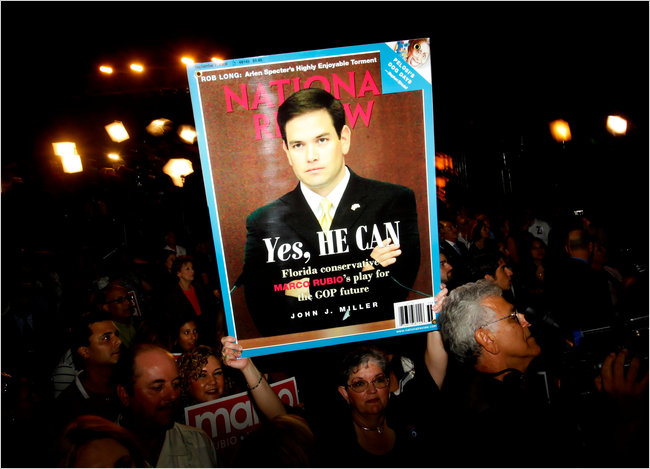

From today's Times (link below):
“He’s our Cuban Barack Obama,”
said Alex Lacayo, 36, a campaign volunteer for
Senator-elect Marco Rubio.
“He gives us hope.”
Ernesto at Penultimos Dias has posted this series of interesting links to reactions and analysis on the election of Cuban-American (hijo orgulloso de exiliados cubanos) Marco Rubio. The plot thickens...
Notimex: El senador electo Marco Rubio dice que fortalecerá línea dura contra Cuba.
PD: Rui Ferreira, en El Mundo, sobre Rubio.
PD2: La interpretación de Rubio de las relaciones Cuba-EE UU puede verse en esta intervención (video), del año pasado.
PD3: Damien Cave en The New York Times, sobre “la gran esperanza conservadora”.
Wednesday, November 3, 2010
Senator-Elect Marco Rubio - "Simply the greatest nation in all of human history"

I was born and raised in Pensacola, Florida. So, who that state's elected officials are interests me. Of course, we all know of Florida's inordinate importance in Presidential electoral politics (remember good ole 2000?). Moreover, Florida has long been the tail that wags the dog of U.S. Cuba policy.
I am also a life-long Democrat, a consistent critic of the Cuban regime who nonetheless favors "principled engagement" with it, and a skeptic who, I'll admit it, rolls his eyes and cringes when he hears the following words:
"Americans believe with all their heart -- the vast majority of them, and the vast majority of Floridians -- that the United States of America is simply the greatest nation in all of human history. A place without equal in the history of all mankind."
So, it goes without saying that if I still lived in Florida, I would NOT have voted for its new senator elect, Marco Rubio (Herald story here and Human Events here). Still, whatever you think about this young, rising star of the tea party movement and Republican Party, El Yuma advises you to do three things now:
Tuesday, November 2, 2010
News Roundup: Taxes, Agriculture, and the Economic and Political Outlook
Here are links to a number of enlightening articles (all from the good people at Reuters) dealing with the fits and starts of Cuban reform in agriculture, the tax system, and self-employment. The last article also contains a bit about U.S.-Cuban relations.
- Reuters' Nelson Acosta on last Monday's release of the new tax code for the self-employed.
- Reuters' Marc Frank on the worries of Cuban farmers over the pace of reform. Two steps forward and one step back. As usual, the English version of the article is shorter and less enlightening than the Spanish version. Still, in both versions Cuban economist Armando Nova is quoted as saying, "The contracting system should be reduced to the indispensable so that most production can be sold on the basis of supply and demand." The Spanish version of the article also includes this provocative critique of Cuba's state food production and distribution system from Cuban economist Juan Triana: "No se puede seguir viviendo presos de cabezas acomodadas que no alcanzan nunca a ver la solución que está al alcance de sus narices" (or to paraphrase: "We can't keep being prisoners of comfortable leaders who never manage to see the solutions that are right under their noses" - thanx to a reader for help on that translation). Also see these older articles and blog posts for useful background on economic debates about the role of Cuba's private sector. Go here from March on agriculture, go here from April on a lecture in New York by Cuban economists Armando Nova and Omar Perez Villanueva, and go here from August on Marc Frank's soundings of Cuban farmers.
- Finally, Reuters' Jeff Franks has this sharp analysis of the key political risks to watch for in Cuba in the months to come (H/T Penultimos Dias).
Pardoned, Not Paroled (Part I)
Renato Pérez Pizarro at Miami Herald's Cuban Colada Blog summarizes an interesting AP article by Paul Haven on the looming November 7 deadline for the final 13 of the promised 52 Cuban prisoner releases.
These final 13, however, refuse to be deported upon release. Pérez Pizarro, says, "They refuse to leave prison unless they are freed without any conditions – pardoned, not paroled."
The article also says that hunger striker and recent winner of Europe's Sakharov human rights prize Guillermo Farinas will stop eating again on Nov. 8 if the remaining dissidents are not in their homes by that date.
Leading dissident Elizardo Sanchez argued that Cuba's leaders have nothing to gain - and everything to lose - by keeping the last 13 prisoners in jail. "By releasing them, the government improves its international image and removes a weight off its back. If it does not, it will gain only the world's condemnation," Sanchez said. "Not freeing them would be unthinkable."
These final 13, however, refuse to be deported upon release. Pérez Pizarro, says, "They refuse to leave prison unless they are freed without any conditions – pardoned, not paroled."
The article also says that hunger striker and recent winner of Europe's Sakharov human rights prize Guillermo Farinas will stop eating again on Nov. 8 if the remaining dissidents are not in their homes by that date.
Leading dissident Elizardo Sanchez argued that Cuba's leaders have nothing to gain - and everything to lose - by keeping the last 13 prisoners in jail. "By releasing them, the government improves its international image and removes a weight off its back. If it does not, it will gain only the world's condemnation," Sanchez said. "Not freeing them would be unthinkable."
Subscribe to:
Comments (Atom)